Altitude's Grip on the Pitch: How Elevation Alters Soccer Play and Betting Lines

High-altitude venues create distinct physical conditions that reshape how soccer unfolds on the field while simultaneously prompting measurable adjustments in pre-match and in-play betting markets. Researchers tracking performance metrics across South American and European competitions have documented reduced oxygen availability at elevations above 2,000 meters, which accelerates fatigue in visiting players unaccustomed to thinner air. This physiological shift alters passing accuracy, sprint frequency, and recovery intervals, producing patterns that betting operators incorporate into line construction.
Stadiums such as Bolivia's Hernando Siles in La Paz sit at roughly 3,600 meters, while Mexico City's Estadio Azteca reaches 2,240 meters. Data collected from CONMEBOL qualifiers between 2022 and 2025 shows home teams at these sites recording 18 percent higher possession retention in the final 30 minutes compared with sea-level matches. Visiting squads from lower elevations exhibit elevated heart rates and shortened high-intensity running distances, facts confirmed through GPS tracking studies published by sports science departments at institutions in Chile and Colombia.
Physiological Demands and Tactical Adjustments
Ball behavior changes noticeably at altitude because lower air density reduces drag and allows greater travel distance on long passes and shots. Goalkeepers have reported requiring adjusted positioning to account for faster trajectories, and set-piece routines often incorporate more direct approaches. Coaches preparing for away fixtures at elevation routinely schedule acclimatization periods of five to seven days, a practice observed across multiple national team camps ahead of 2026 World Cup qualifiers scheduled for July. Teams that arrive with shorter preparation windows show steeper drops in expected goals, according to match analytics compiled by Opta and similar providers.
These performance differentials feed directly into market pricing. Bookmakers widen goal totals and adjust handicap lines when lower-altitude sides travel upward, reflecting historical results rather than speculation. Live betting volumes increase during the opening 15 minutes as traders monitor early tempo to confirm whether the expected fatigue curve materializes.
Betting Market Responses to Elevation Data
Pre-match totals markets typically open 0.25 to 0.5 goals lower for high-altitude fixtures involving sea-level visitors. In-play algorithms then recalibrate these numbers based on real-time metrics such as distance covered and successful pass completion. Operators drawing on historical datasets from the Bolivian Primera División and Mexican Liga MX have refined models that predict second-half goal suppression more accurately when elevation exceeds 2,500 meters. Sharp bettors who monitor line movements often target unders after observing early overreactions in totals, especially when one side demonstrates rapid adaptation.
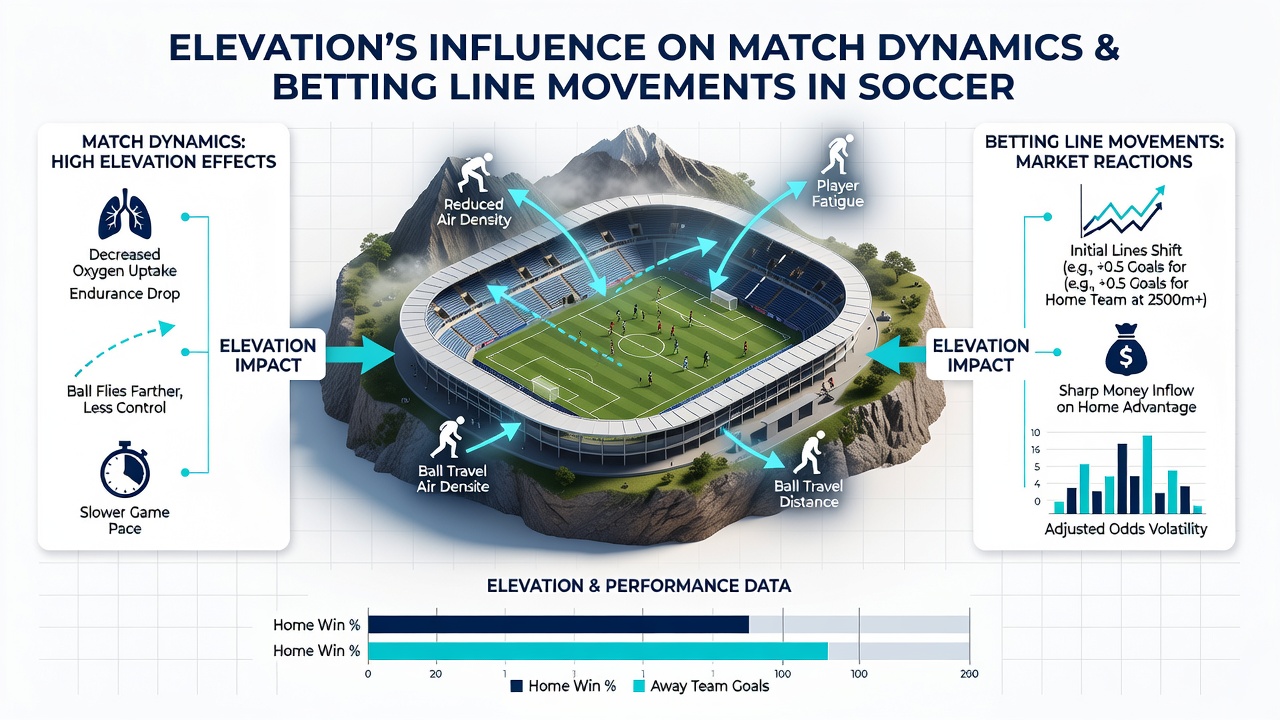
European leagues encounter fewer extreme cases yet still register measurable effects at venues above 1,000 meters, including certain Swiss and Austrian grounds. A 2024 analysis by the German Sport University Cologne examined Bundesliga matches and identified a 7 percent reduction in total distance run by visiting teams at higher sites, correlating with modest but consistent shifts in both corners and cards markets. These findings prompted several operators to incorporate elevation variables into their automated pricing engines.
Regional Patterns and Data Sources
Matches in the Andean region produce the clearest statistical signatures, whereas North American and Asian venues rarely reach comparable heights. July 2026 preparations for international fixtures have already prompted several federations to release updated acclimatization guidelines that reference prior elevation studies. Betting exchanges report elevated trading activity on South American qualifiers when altitude differentials exceed 1,500 meters, with liquidity concentrated in first-half goal lines and player performance props tied to distance covered.
Industry reports from the Asia-Pacific region and North American gaming associations further illustrate how operators diversify risk models to account for environmental variables. These models integrate weather data, travel distance, and historical recovery timelines to generate dynamic odds that move faster than static pre-match lines.
Conclusion
Elevation influences both on-field execution and market pricing through documented physiological and aerodynamic effects. Historical match data, GPS tracking, and operator pricing records demonstrate consistent patterns that continue to shape how lines open and adjust across competitions. As teams refine preparation protocols ahead of major 2026 events, these environmental factors remain central to performance forecasting and market efficiency.