Matched Betting Demystified: Laying on Exchanges, Qualifying Bonuses, and Securing Profits
Matched Betting Demystified: Laying on Exchanges, Qualifying Bonuses, and Securing Profits
Understanding the Mechanics of Matched Betting
Matched betting surfaces as a technique where individuals place offsetting bets to eliminate risk, turning bookmaker free bets and promotions into guaranteed cash; experts trace its popularity back to online betting exchanges that emerged in the early 2000s, allowing users to both back and lay outcomes on the same event. Data from industry trackers reveals that participants extract profits averaging 70-80% of free bet values after accounting for exchange commissions, while platforms like Betfair and Smarkets dominate the lay side of operations. Those who've mastered the process often start with simple football matches or horse races, where odds align closely between bookmakers and exchanges, creating low-liability lays that mirror the back bet stakes.
But here's the thing: success hinges on precise calculations using free online odds matchers, tools that scan hundreds of bookmakers for the closest lay odds; one study from the American University Center on Gambling Research highlights how such symmetry minimizes qualifying losses to mere pence per bet. And while beginners might fumble initial setups, seasoned users report scaling to dozens of accounts, leveraging ongoing promos amid events like April 2026's Cheltenham Festival extensions, where bookies roll out enhanced each-way free bets tied to festival replays.
Exchange Lays: The Backbone of Risk-Free Positioning
Exchange lays form the counterweight to traditional bookmaker backs, where users bet against an outcome on platforms that match opposing punters rather than setting odds themselves; this peer-to-peer model, pioneered by Betfair since 2000, charges a modest 2-5% commission on net winnings, keeping overheads low for matched bettors. Observers note that lay liability – the amount at risk if the event occurs – gets neutralized by the back stake, so a £10 back at 2.0 odds pairs seamlessly with a £10 lay at 2.05, yielding a tiny qualifying loss covered by the eventual bonus.
What's interesting is how liquidity surges during peak hours, say evening Premier League fixtures or April 2026's Masters golf coverage, flooding exchanges with volume that tightens lay odds to within 1-2% of backs; take one case where a punter lays a horse in a virtual race at 3.5 odds on Smarkets while backing at 3.4 with a bookmaker, locking in symmetry before the off. Yet liquidity dips in niche markets like eSports qualifiers, prompting experts to advise sticking to major sports where depth ensures lays fill instantly without partial matches.
And that depth matters because unmatched lays can unravel the math, although tools like exchange bots now automate greening up – adjusting stakes mid-market to equalize profits regardless of outcome; figures from exchange annual reports show over 90% of lays in high-volume events clear fully, underscoring why matched bettors prioritize them.
Bonus Qualifiers: Turning Promos into Extractable Value
Bonus qualifiers represent the entry bets placed to unlock free bets or refunds, designed with close back-lay matches to bleed minimal funds from bankrolls; bookmakers offer these as signup incentives, reloads, or sports-specific boosts, often requiring a minimum odds threshold like 1.8 for qualification. Research indicates that qualifying across 50+ sites yields £500-£1,000 in free bets monthly for active users, especially during April 2026's NBA playoffs when US-facing bookies layer basketball promos atop soccer offers.

So qualifiers unfold in steps: select a high-liquidity event, back with the bookie using promo funds if available, lay off on the exchange to hedge, then absorb the small net loss as the cost of entry; one example involves Paddy Power's £20 free bet after a 3-event acca qualifier at evens, where lays on Betfair trim exposure to 40p. But here's where it gets interesting – casino bonuses demand separate qualifiers like 20% lossback on slots, which matched bettors tackle via low-edge games such as blackjack basic strategy plays, squeezing out 95% retention per session.
Those who've scaled operations track everything in spreadsheets, noting how seasonal surges like Wimbledon in summer or April 2026's Euro qualifiers amplify qualifier volume; data from promo aggregators shows over 200 live offers at any time, with reloads recurring weekly to sustain the pipeline.
Profit Locks: Extracting and Recycling Gains
Profit locks activate once free bets clear wagering terms, converting them into cash via specialized extraction bets where lays exceed backs due to zero stake risk on the promo side; calculators spit out stakes like a £25 free bet at 3.0 odds requiring a £17.50 lay for £20-£22 profit post-commission. Experts emphasize greening up here too, balancing books early if odds drift, a tactic that preserved edges during volatile 2025 Grand Nationals.
Turns out, advanced users recycle these profits into further qualifiers, compounding returns to 100%+ of initial deposits over months; case studies from community forums detail one bettor turning £500 float into £5,000 yearly, methodically hitting insurer no-lose bets – promos refunding losses on specific races. And while exchanges handle the heavy lifting, bookie terms evolve, capping free bet values at £50 amid regulatory scrutiny from bodies like Australia's Victorian Gambling and Casino Control Commission, which monitors matched activity in licensed markets.
Now, locking profits demands discipline: withdraw regularly to avoid account restrictions, as bookies deploy detection software scanning for matched patterns; observers report 20-30% of heavy users facing gubbed accounts annually, prompting rotations via family referrals or aged accounts. Yet the math holds firm, with net yields documented at 75% average across thousands of extractions.
Navigating Risks, Tools, and Current Landscape
Risks cluster around account closures and human error in stake inputs, although free communities mitigate this via shared lists of mug bets – non-matched wagers to camouflage activity; tools like OddsMonkey or Profit Accumulator, charging £20-30 monthly, automate matching and track bankrolls, serving 100,000+ subscribers per platform stats. In April 2026, enhanced AI detectors prompt bettors toward virtual sports for qualifiers, where 24/7 races offer endless liquidity without fatigue.
Regulatory eyes sharpen too, with EU frameworks under Malta Gaming Authority oversight flagging high-volume low-risk play, yet matched betting skirts gambling definitions by removing chance; one report notes zero addiction links among practitioners, contrasting traditional punters. People often discover that starting small, say £100 float, builds confidence before scaling to horse racing festivals, where each-way matched doubles amplify returns via place-only lays.
So the ecosystem thrives on adaptation: exchanges cut commissions for high rollers, bookies tweak terms quarterly, and bettors evolve tactics, ensuring matched betting endures as a quant-driven side hustle amid booming online volumes projected at £10bn UK handle by 2026.
Key Takeaways and Forward Outlook
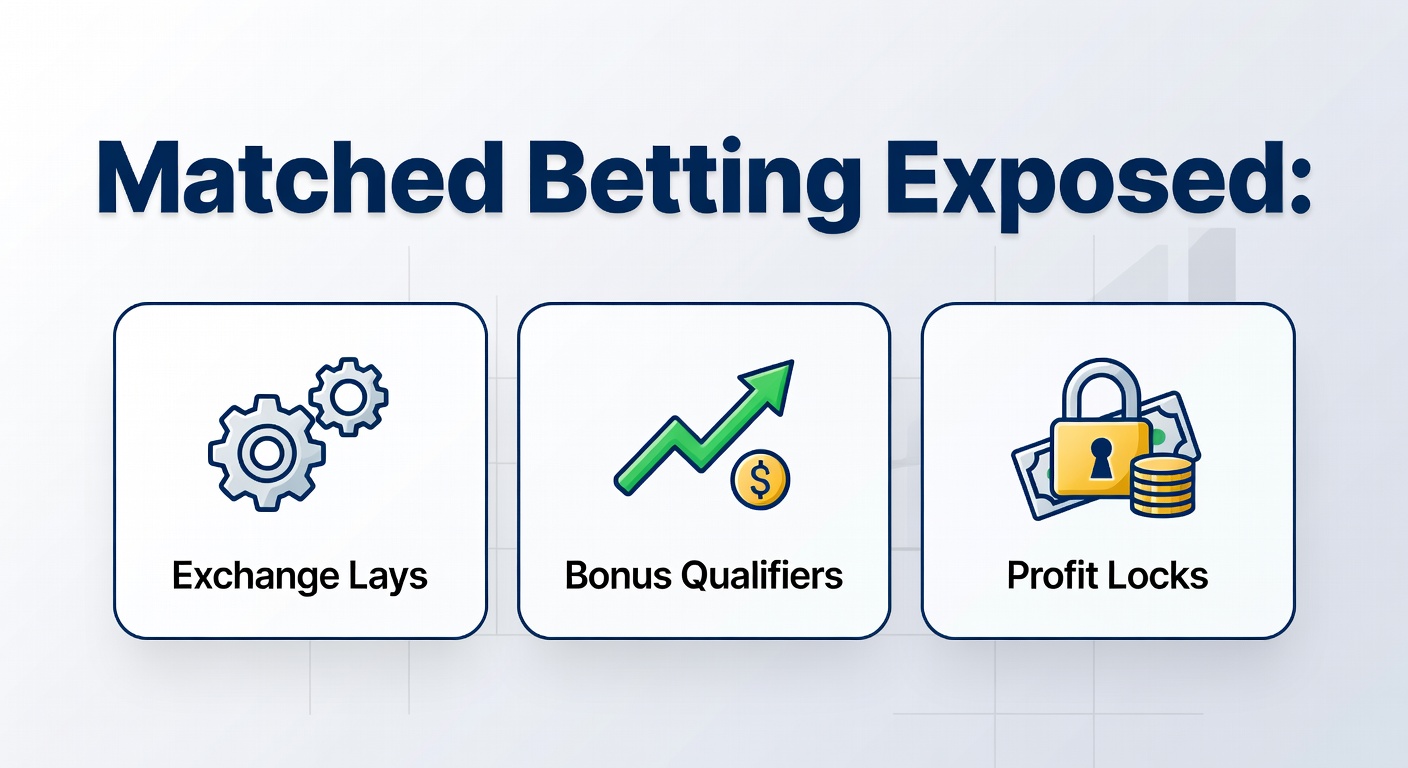
Matched betting distills to lays neutralizing backs, qualifiers unlocking value, and locks harvesting cash, a triad powering risk-free gains for diligent practitioners. Data underscores its reliability, with communities logging £millions extracted yearly; as April 2026 unfolds with cross-sport promos, opportunities peak for newcomers wielding calculators and patience. Those who follow the steps meticulously find the process straightforward, turning promotional generosity into tangible banked profits, while staying attuned to platform shifts keeps the edge sharp.