Statistical Modeling of Odds Fluctuations in Championship Football Matches
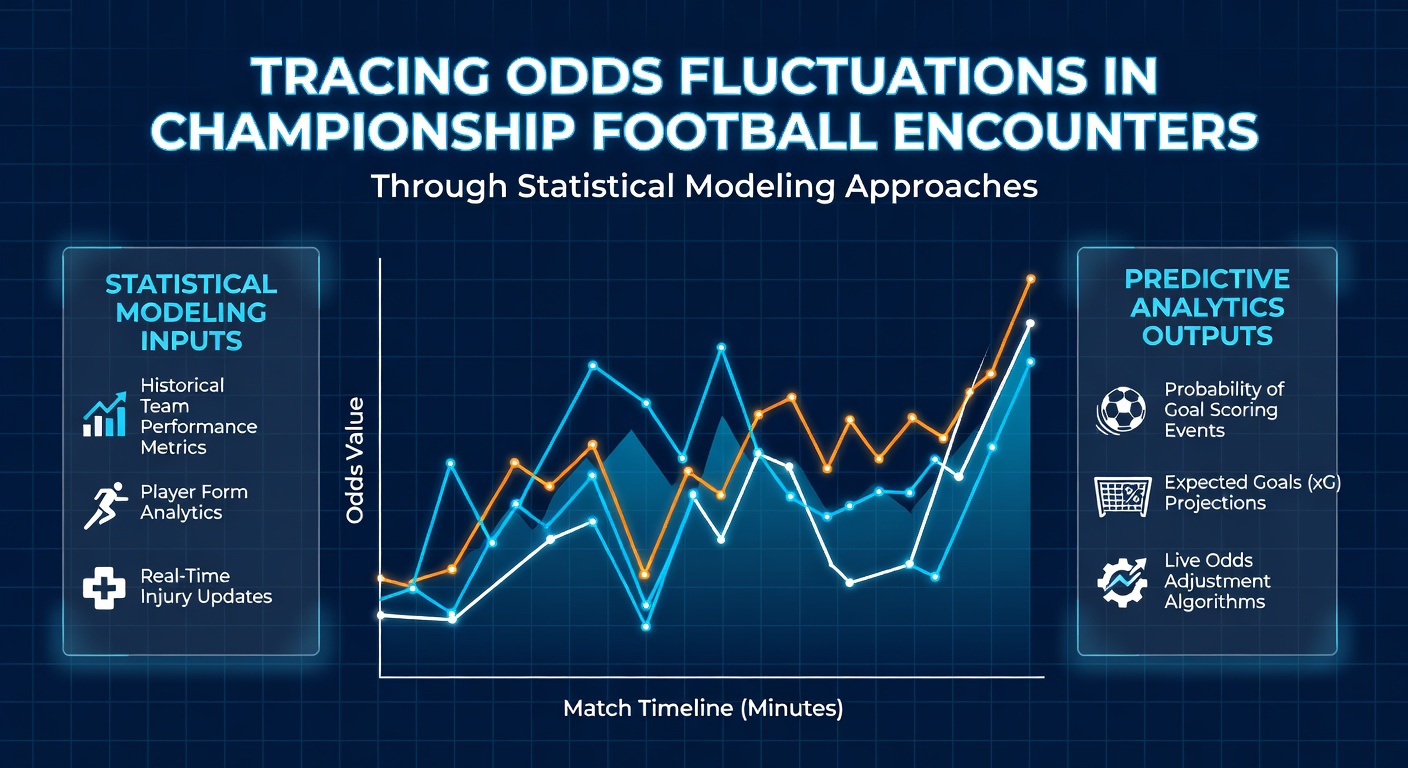
Championship football encounters generate constant movement in betting markets, and statistical modeling provides structured ways to trace those shifts across an entire season. Observers note that odds respond to new information such as team selections, weather reports, and early-match events, yet the underlying patterns remain measurable when appropriate techniques receive consistent application.
Core Drivers Behind Market Movements
Multiple variables influence how bookmakers adjust prices during championship fixtures, and researchers have isolated several that recur across leagues. Injury updates arrive through official club channels and alter expected goal outputs, while referee assignments carry documented effects on card and foul rates. Form streaks appear in recent results, yet models weight them against opponent strength rather than treating them as standalone signals. Data shows that late-afternoon team news on weekends produces sharper revisions than midweek announcements because liquidity concentrates around popular fixtures.
Market makers also incorporate broader context such as fixture congestion and travel distance between venues. Analysts at the German Football Association have tracked how back-to-back away games correlate with measurable declines in pressing intensity, and those patterns feed directly into pre-match probability estimates. When such factors align, odds drift occurs in predictable directions even before kickoff.
Established Modeling Frameworks
Poisson distributions remain foundational for projecting scorelines because they convert average goal rates into full probability matrices for every possible outcome. Analysts combine these distributions with bivariate adjustments that account for correlation between home and away scoring, and the resulting matrices translate into implied probabilities that bookmakers compare against their current odds. Regression models then layer additional predictors including expected goals from underlying shot data and set-piece conversion rates, which sharpens estimates when historical samples grow large enough for reliable coefficients.
Machine-learning approaches extend these foundations by processing high-dimensional inputs such as player tracking metrics and passing network structures. Gradient-boosted trees and neural networks identify non-linear interactions that simpler regressions miss, and cross-validation routines prevent overfitting on smaller championship datasets. Studies from the University of Sydney sports analytics group demonstrate that ensemble methods combining Poisson baselines with gradient boosting reduce forecast error by measurable margins when tested on multiple seasons of second-tier English matches.

Real-Time Updating Procedures
Live modeling requires continuous recalibration once matches begin, and in-play systems refresh probabilities after every significant event. Goal-scoring updates trigger immediate recalculation of remaining expected goals, while red cards shift both scoring rates and variance parameters because numerical disadvantage alters tactical choices. Kalman filters and particle filters provide recursive estimation frameworks that blend new observations with prior beliefs without requiring full model refits after each minute of play.
Championship schedules in May 2026 include playoff semi-finals and promotion deciders that compress these dynamics into short windows, and operators adjust update frequencies accordingly. Higher betting volumes during those weeks supply richer data streams, which in turn improves the stability of real-time parameter estimates. Teams monitoring these feeds observe that models incorporating substitution patterns and fatigue indicators capture momentum shifts earlier than those relying solely on scoreline and time remaining.
Validation and Performance Tracking
Back-testing across historical championship seasons reveals where models require refinement, and calibration plots compare predicted probabilities against observed frequencies. When deviations appear consistently in specific scoreline regions, analysts introduce additional covariates such as home advantage decay after international breaks. Industry reports from the European Gaming and Betting Association highlight that transparent validation processes help operators maintain competitive margins while responding to genuine information advantages held by sophisticated bettors.
Out-of-sample testing on recent seasons further confirms that hybrid models outperform pure Poisson or pure regression specifications, particularly when matches feature extreme weather or unusual pitch conditions. Observers tracking these comparisons emphasize that continuous monitoring remains essential because rule changes and tactical evolution gradually erode the relevance of older training data.
Conclusion
Statistical modeling supplies reproducible methods for following odds fluctuations throughout championship football campaigns, and the integration of established distributions with modern machine-learning tools continues to refine accuracy. As May 2026 approaches and decisive matches multiply, the same frameworks that processed earlier rounds will face fresh tests against heightened market activity and compressed decision windows. Organizations that maintain disciplined validation routines position themselves to interpret those movements with greater consistency across varying conditions.